
Past the Plateau: Continuing Education for Teachers
Most teachers plateau after the 200-hour — not from lack of talent but because daily teaching rewards what already works. How structured training breaks the loop.

Most teachers plateau somewhere in the second year after their 200-hour training, and it isn't a motivation problem. It's structural: day-to-day teaching rewards what already works. The sequences that land get reused, the cues that get nods get repeated, and within a year you've distilled a reliable, polished, closed set of tools. Students are happy. Classes fill. And your teaching has quietly stopped changing.
Structured continuing education is how the loop breaks — not because certificates matter in themselves, but because a good training forces material through you that the feedback loop of a happy class never would.
Why the plateau is invisible from inside
The 200-hour gives you survival skills: a sequence template, a cue vocabulary, enough anatomy to avoid harm. Teaching then optimizes those skills against one metric — does the room respond? — which is real but narrow. The room can't respond to what you never offer. Nobody requests the pelvic-floor cue you don't know, the nervous-system framing you haven't learned, the modification for the student who quietly stopped coming because nothing in class fit her body.
The plateau feels like mastery because everything you attempt succeeds. The tell is on the planning side: classes get easier to write and the plans start rhyming.
Your students inherit the depth of your own study. Keep being a student.
Choosing depth over sampling
The instinct, once you decide to study again, is to sample broadly — a weekend of this, a webinar of that. Sampling produces notebooks; depth produces changed teaching. One area, one season, taken seriously:
Anatomy and biomechanics compounds more than anything else, because the same lens upgrades every sequence you'll ever write and every adjustment you'll ever consider. If you've never done a dedicated anatomy training, it's the default recommendation.
Restorative and nervous-system work transforms the half of teaching that vinyasa-centric trainings barely touch: the descent, the rest, the students who come to class carrying a hard year. It also future-proofs you — the demographic curve of yoga is pointing this direction.
Specialty populations — prenatal, seniors, athletes, injury recovery — turn the students you currently teach around into students you teach for. One specialty credential also does more for studio scheduling conversations than three general ones.
Sequencing intensives sharpen the architecture skills covered in our sequencing piece: peak decomposition, arc design, theming that's more than a quote at the start.
Making hours count twice
If you maintain a Yoga Alliance registration, you owe continuing-education hours on a rolling three-year cycle anyway — so choose programs whose hours register. Accredited online trainings (our partner YogaRenew's 200-hour and specialty courses among them, linked in the Learn panel's partner section) let you study around a teaching schedule and bank the registration hours at the same time. Self-paced study is real study; the discipline is in applying it.
The application rule
A module that doesn't reach your students within a week usually never does — the half-life of unapplied training material is brutal. So adopt one rule for any training you take: one idea per module goes into your very next class, while it's still uncomfortable and new.
Keep the loop honest with applied notes: after the class where you tried the new cue or the restructured descent, write three lines — what you tried, what the room did, what you'd change. A page of these beats a binder of course notes, because it's a record of your teaching changing rather than of content you once saw. (Your class notes in the planner are a fine place for them — attached to the actual lesson, where next season's planning will trip over them again.)
A season-by-season cadence
Sustainable continuing education looks less like a heroic sabbatical and more like a rhythm: one substantial training per year, one application focus per season, observation of another teacher's class once a month as a student with the notebook closed. Spread this over five years and you end up with anatomy depth, a restorative toolkit, a specialty, and several hundred registered hours — a genuinely different teacher than the one the 200-hour produced, with no single year that felt like overload.
The plateau isn't a verdict. It's just what happens when the inputs stop. Restart the inputs.
Keep reading

Sequencing: Arc, Peak, and the Class That Feels Inevitable
How to build a class that earns its peak and lands its rest — choosing the peak first, reverse-engineering the warm-up, and pressure-testing the arc.
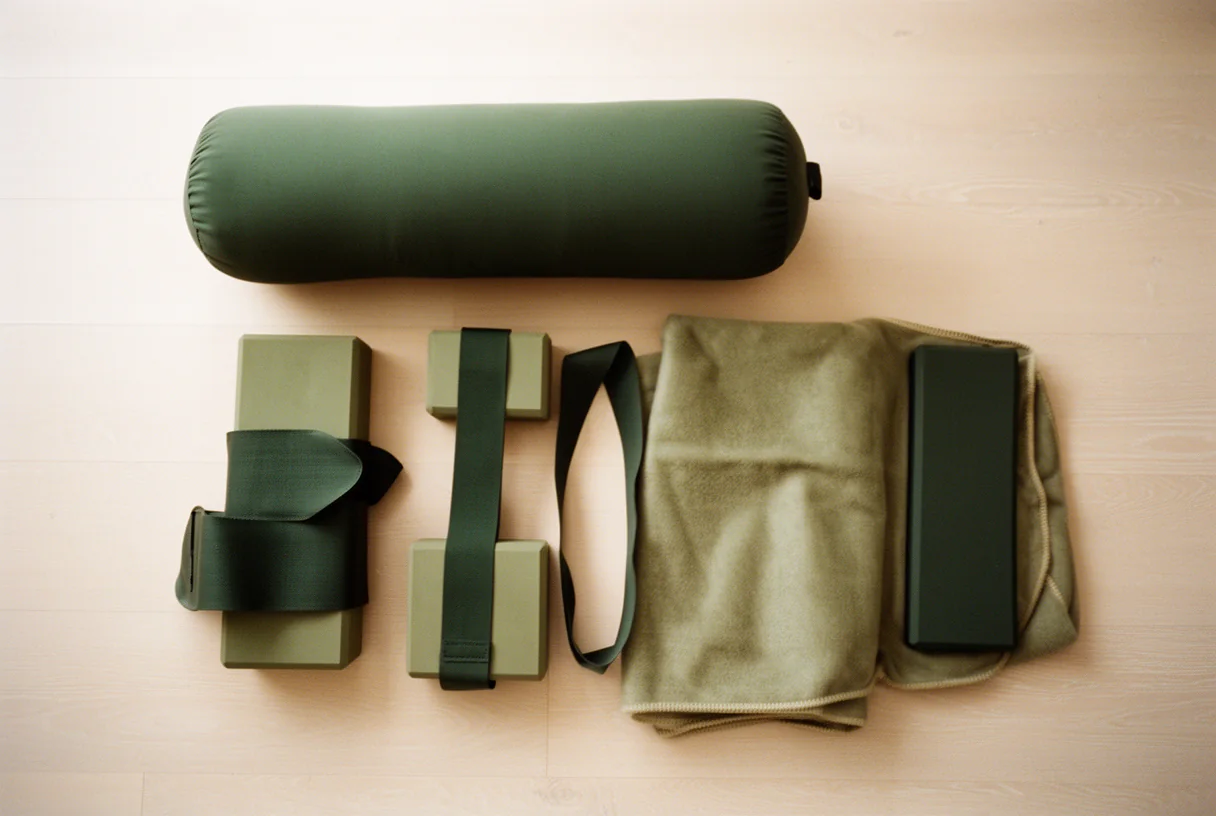
Props and Modifications: Bringing the Pose to You
Blocks, straps, and bolsters aren't training wheels — they change the geometry of a pose so today's body can do the pose's actual work.